Assessment of Heart Rhythm and Arrhythmia Detection from Electromyographic Signals Using a Convolutional Neural Network


The aim of the study is to develop and validate an algorithm based on a convolutional autoencoder for assessing heart rhythm from surface electromyography (EMG) signals recorded by the EMG system Myosuit. The use of this system is intended to expand the capabilities for subsequent development of integrated systems for non-invasive monitoring of functional status (fatigue, stress, and cardiac arrhythmias).
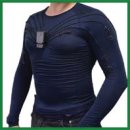
Materials and Methods. The study involved 6 healthy male subjects (mean age 21±2 years). Synchronous recording of EMG signals was performed using the EMG system Myosuit, the VNS-Micro electrocardiograph, and the Polar H10 monitor at rest, as well as during static and dynamic bicep contractions.
Results. A fully convolutional autoencoder, trained on binary R-wave masks, was developed to extract the corresponding components of the cardiac cycles from the EMG recordings. The model’s performance was evaluated using the F-score in three scenarios: (i) on pooled data from all subjects; (ii) with one subject excluded from training and tested on their data (leave-one-subject-out); (iii) on the personal data of each subject individually. Based on EMG signals recorded from the pectoralis major muscle by the EMG System Myosuit sensors, the convolutional autoencoder demonstrated the feasibility of constructing a rhythmogram — a sequence of R–R intervals essential for heart rate variability analysis and arrhythmia screening. In Scenario (i), the maximum F-score was achieved for EMG signals at rest and during static bicep exercise; classification performance remained high during dynamic bicep exercise. The results of Scenario (ii) indicate that the system reliably operates when tested on data from a subject excluded from the training set. Scenario (iii) yielded the worst results. Given the algorithm’s high generalization capability for data not included in the training set, Scenario (ii) represents the most realistic application use case and demonstrates the best overall performance.
Conclusion. The feasibility of using the universal EMG electrodes of the EMG System Myosuit for simultaneous monitoring of muscle activity and heart rate has been confirmed. The developed algorithm demonstrates high performance in the task of extracting a rhythmogram from EMG signals both at rest and during muscle load. This opens prospects for creating cost-effective wearable systems for the comprehensive assessment of functional status and real-time screening for cardiac arrhythmias without the need for a separate ECG channel.
- Teo K.K., Rafiq T. Cardiovascular risk factors and prevention: a perspective from developing countries. Can J Cardiol 2021; 37(5): 733–743, https://doi.org/10.1016/j.cjca.2021.02.009.
- Arakaki X., Arechavala R.J., Choy E.H., Bautista J., Bliss B., Molloy C., Wu D.A., Shimojo S., Jiang Y., Kleinman M.T., Kloner R.A. The connection between heart rate variability (HRV), neurological health, and cognition: a literature review. Front Neurosci 2023; 17: 1055445, https://doi.org/10.3389/fnins.2023.1055445.
- Ishaque S., Khan N., Krishnan S. Trends in heart-rate variability signal analysis. Front Digit Health 2021; 3: 639444, https://doi.org/10.3389/fdgth.2021.639444.
- Parin S., Polevaia A., Polevaia S. A neurochemical framework to stress and the role of the endogenous opioid system in the control of heart rate variability for cognitive load. COGNITIVE 2017: The Ninth International Conference on Advanced Cognitive Technologies and Applications 2017; 24: 16–20.
- Peltola M.A. Role of editing of R-R intervals in the analysis of heart rate variability. Front Physiol 2012; 3: 148, https://doi.org/10.3389/fphys.2012.00148.
- von Tscharner V., Eskofier B., Federolf P. Removal of the electrocardiogram signal from surface EMG recordings using non-linearly scaled wavelets. J Electromyogr Kinesiol 2011; 21(4): 683–688, https://doi.org/10.1016/j.jelekin.2011.03.004.
- Willigenburg N.W., Daffertshofer A., Kingma I., van Dieën J.H. Removing ECG contamination from EMG recordings: a comparison of ICA-based and other filtering procedures. J Electromyogr Kinesiol 2012; 22(3): 485–493, https://doi.org/10.1016/j.jelekin.2012.01.001.
- Lu G., Brittain J.S., Holland P., Yianni J., Green A.L., Stein J.F., Aziz T.Z., Wang S. Removing ECG noise from surface EMG signals using adaptive filtering. Neurosci Lett 2009; 462(1): 14–19, https://doi.org/10.1016/j.neulet.2009.06.063.
- Mak J.N., Hu Y., Luk K.D. An automated ECG-artifact removal method for trunk muscle surface EMG recordings. Med Eng Phys 2010; 32(8): 840–848, https://doi.org/10.1016/j.medengphy.2010.05.007.
- Nougarou F., Massicotte D., Descarreaux M. Efficient procedure to remove ECG from sEMG with limited deteriorations: extraction, quasi-periodic detection and cancellation. Biomed Signal Process Control 2018; 39: 1–10, https://doi.org/10.1016/j.bspc.2017.07.019.
- Hou C., Cai F., Liu F., Cheng S., Wang H. A method for removing ECG interference from lumbar EMG based on signal segmentation and SSA. IEEE Sensors Journal 2022; 22(13): 13309–13317, https://doi.org/10.1109/jsen.2022.3179434.
- Gierałtowski J., Ciuchciński K., Grzegorczyk I., Kośna K., Soliński M., Podziemski P. RS slope detection algorithm for extraction of heart rate from noisy, multimodal recordings. Physiol Meas 2015; 36(8): 1743–1761, https://doi.org/10.1088/0967-3334/36/8/1743.
- Weiss R., Karimijafarbigloo S., Roggenbuck D., Rödiger S. Applications of neural networks in biomedical data analysis. Biomedicines 2022; 10(7): 1469, https://doi.org/10.3390/biomedicines10071469.
- Ronneberger O., Fischer P., Brox T. U-Net: convolutional networks for biomedical image segmentation. In: Navab N., Hornegger J., Wells W., Frangi A. (editors). Medical Image Computing and Computer-Assisted Intervention — MICCAI 2015. MICCAI 2015. Lecture Notes in Computer Science, vol 9351. Springer, Cham, https://doi.org/10.1007/978-3-319-24574-4_28.
- Chicho B.T., Bibo Sallow A. A comprehensive survey of deep learning models based on Keras framework. J Soft Comput Data Min 2021; 2(2): 49–62, https://doi.org/10.30880/jscdm.2021.02.02.005.
- Pimashkin A.S., Sesekin G.N., Khoruzhko M.A., Kazantsev V.B., Gordleyeva S.Yu., Kastalsky I.A., Lee A.N., Lobov S.A., Mironov V.I., Mishchenko M.A., Salikhov R.A., Khramov A.E. Flexible tensile cable. Patent RU 223 063. 2024.
- Pimashkin A.S., Sesekin G.N., Khoruzhko M.A., Kazantsev V.B., Gordleyeva S.Yu., Kastalsky I.A., Lee A.N., Lobov S.A., Mironov V.I., Mishchenko M.A., Salikhov R.A., Khramov A.E. A device in the form of a piece of clothing for recording and correcting muscle activity. Patent RU 223 369. 2024.
- Kastalskiy I., Mironov V., Lobov S., Krilova N., Pimashkin A., Kazantsev V. A neuromuscular interface for robotic devices control. Comput Math Methods Med 2018; 2018: 8948145, https://doi.org/10.1155/2018/8948145.
- Obi J.C. A comparative study of several classificationmetrics and their performances on data. World J Adv Eng Technol Sci 2023; 8(1): 308–314, https://doi.org/10.30574/wjaets.2023.8.1.0054.
- Costa Junior J.D., de Seixas J.M., Ferreira Leite Miranda de Sá A.M. Reducing electrocardiographic interference in the multichannel electromyogram to help muscle fatigue assessment in low-intensity contractions. Franklin Open 2024; 9: 100177, https://doi.org/10.1016/j.fraope.2024.100177.